Author: readyallrow

One, excellence comes from preparation. Athletes spend 90 percent of their effort in preparing for the game and 10 percent playing the game. If we used that ratio of 90 percent preparation to 10 percent performance we would achieve excellence. Two, perfection is a moving target. But excellence is within reach. Two simple and inarguable truths. Excellence comes from consistent improvement. Dedication to preparation and practice yields increased excellence. Perfection cannot even be defined, let alone achieved. I won’t be perfect, I might not even be excellent when I begin. But I know how to achieve excellence and that is as close to perfect as I ever need to be.

Coxswain skills: Evaluating races

Coxing Racing

Coxswain skills: Evaluating races

Previously: Steering, pt. 1 || Steering, pt. 2  || Boat feel || How to handle a negative coxswain eval || How to cox steady state workouts || How to cox short, high intensity workouts || Race steering || Steering a buoyed course || Evaluating practices

Following up on September’s post on evaluating practices, today’s post is gonna talk about evaluating your race performance. Given that the biggest race of the fall season for most of us is now over and the hangover (either from racing or Ned Devine’s) has worn off, today seems like a good day to reflect back on how we did.

Related: Evaluating practices

Similarly to when you’re looking back on practice, there’s a lot of different variables you can look at to determine if your performance was up to par (and no, winning is not one of them – you can win and cox like shit just like you can lose and still cox a good race). There’s some carryover between the two but below are the ones I fall back on the most when talking with our coxswains, regardless of whether we’re talking about sprint or head races.

Did you execute the race plan effectively and if you had to deviate from it, did you do so in a way that was easily understood by the crew?

I’ve extolled the virtues of race plans enough times that you should know by now that there’s no excuse for not having one. Plan A, Plan B, Plan C … gotta have ’em all because you never know when you’re gonna need to make the switch because the race is developing differently than you’d originally planned. The better acquainted you and your crew are with the plan before launching for your race, the smoother the transition will be if you need to make that jump. Having to do this during a race is a good test of your composure, your ability to stay focused, and your awareness of how the race is developing around you and how you need to adapt to it.

Did you work towards and/or achieve your personal goals for that day?

Usually with our coxswains this involves something related to race management, steering, and/or communication with the crew. This is a big one for us because we’re always talking about what we did well during this race that we want to carry over to next week (and continue to improve on, implement more frequently, etc.), as well as what we didn’t do well that we need to work on throughout the week so that it’s done better during the next race. We discuss their goals before the race, immediately after, and then more in depth when we go over the video and having that conversation consistently throughout the week is one of the things that helps keep them on track.

Did you make technical corrections that contributed to an increase in boat speed?

This is a question that carries over from the previous post where I talked in more detail about how to determine if your technical calls are effective. Obviously during a race it’s too late to be coaching a rower or crew’s technique but you can/should still make simple, targeted calls that address issues if/when they pop up (i.e. “shape the finishes” if the blades aren’t coming out cleanly, particularly in rough water like we had all weekend). This is crucial during a race because if your technique is off just enough to slow you down 0.001 seconds per stroke, that’s 2 seconds over the course of 2000 meters, which at this level (collegiate men) can equate to nearly a boat length.

These post-race reflections are easily done without audio or GoPro but they’re so much more effective if you’ve got a recording on hand that you can go through, analyze, and get feedback on. GoPro is even better but the caveat, for you at least, is that your performance and execution skills will get scrutinized and critiqued a lot more because you can see your course, the bladework, etc. and how well you’re doing relative to each of those things.

The Wisco race from this past spring is good example of this. If we’d just had the audio I think we’d all agree that it was a solid performance by our coxswain but because we had the GoPro video too, there were a lot of things that stood out where if he’d executed XYZ better, attacked certain areas of the course with a little more fire, etc. that race could/would have been closer. And yea, I agree that it’s absolutely nitpicky as fuck but that’s also the nature of the game.

Related: MIT Men’s Rowing V8+ vs. Wisconsin

The great thing about going over that video with our coxswain (who was a freshman at the time) was that all the stuff I wanted to point out and say “we need to do this better”, he said first. I remember leaving that meeting and being so impressed because all I really had to do was help refine whatever plan he’d come up with to work on each of the areas where he felt he needed to improve. The one or two things that I pointed out that he hadn’t already mentioned, we discussed so that it made sense to him and then he  followed up with “OK, how would you do it?” or “What should I do/say next time?”. That’s a HUGE sign of maturity in a coxswain and ultimately plays a big part in how effective these post-race (or post-practice) self-evaluations are.

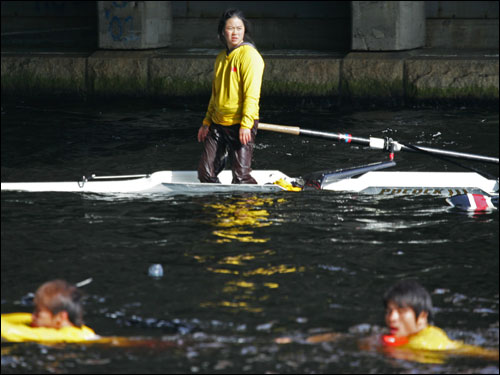
Image via // @rowingcelebration

Video of the Week

Video of the Week: Behind the scenes of “The Boys of ’36”

Back in August PBS aired their documentary on the crew from The Boys in the Boat that they shot in Seattle with some of the UW guys. This video is a quick behind-the-scenes clip that shows the guys talking about what it was like rowing in a wooden hull with the spoon blades and in the much shorter half-slide style that was common back then.

HOCR: Setting up for Weeks

Coxing Racing

HOCR: Setting up for Weeks

Previously: Getting to the starting line || Steering through the bridges || Landmarks along the course || Steering around the turns || Race plans || My general race plan || Yaz Farooq’s coxswain clinic || Race plan “hacks” || The course in meters || Weeks, Lowell House, and “the turning tree”

Two years ago Pete Cipollone was on the Rowing Illustrated podcast talking about how to take the Weeks turn. I’ve talked about Weeks before in a previous post but if you’re looking for some last minute tips, here’s a few from the guy who’s won HOCR seven times and whose course record still stands (13:58.9, set in 1997 if you’re curious).

Related: Pete Cipollone’s 1997 HOCR Recording

Setting yourself for the turn is easier than you think, provided you give yourself plenty of room to execute it and position yourself in the middle of the course coming down the Powerhouse stretch. Despite what you’ve probably heard from your coach about staying tight to the buoys, this is one spot (of many, tbh) where you don’t want or need to do that. If you’re confident in your rudder system and the strength of your bow and 3-seat then you can hug them a little tighter but the “ideal” position is about a full boat length off the buoys.

Related: Taking the Weeks turn with the Carl Douglas “Aerowfin”

There are two ways to know if you’ve nailed the turn – the first is if you’re done steering before you hit the bridge. If you’re going through the bridge at an angle and you’re pretty much completely off the rudder already, you nailed it. The other visual cue is if your port side’s blades miss the abutment by a foot or less. I’ve talked about this before but for me personally, I know that when I have the momentary feeling of “oh shit I’m gonna hit the bridge”, that’s how I know we’re right where we need to be.

Related: Weeks, Lowell House, and “the turning tree”

The last part of managing the turn is thinking ahead to Anderson, which you should be doing before you even enter Weeks. Coming out of the turn, provided you started it early enough and are done steering before you go through the bridge, you want to be pointed straight ahead at the outside abutment of Anderson Bridge (the one between the Boston arch that contains the traveling lane and the center racing arch).

Related: Steering through the bridges

A lot of coxswains, particularly those who are racing at HOCR for the first time, have a tendency to wait too long to start their turns which then throws them super wide coming through Weeks, which then means they’ve gotta do an S-curve to get back into position to be lined up for Anderson. You can save yourself a lot of stress and steering by thinking a bridge or two ahead so that you’ve got plenty of time to get set up and make adjustments to your course if necessary if there’s other crews in your way.

Image via // hocr.org

Coxing Racing Video of the Week

Video of the Week: That time a boat sank at HOCR

Legend has it that the coxswain of this eight (from a university in China) got held up at customs and wasn’t allowed into the United States. None of the rowers spoke English which meant not only did they have to find a coxswain, they had to find one that spoke Mandarin. Luckily they found someone at MIT who spoke Mandarin and could cox but they later found out (too late, of course) that she and the rowers spoke different dialects of Mandarin which meant they could barely understand each other. This proved particularly problematic when they collided with another boat and eventually sank two miles later. It also produced what is probably one of the greatest photos of a coxswain ever. Good luck this weekend!

Erg Playlists

Music to erg to, pt. 132

Last weekend before Head of the Charles. If you wanna do some last minute prep, check out these posts:

HOCR: Getting to the starting line

HOCR: Steering through the bridges

HOCR: Landmarks along the course

HOCR: Steering around the turns

HOCR: Race plans

HOCR: Yaz Farooq’s coxswain clinic

HOCR: The course in meters (roughly)

HOCR: Weeks, Lowell House, and “The Turning Tree” (video included)

Taking the Weeks turn with a new fin on the Empacher (video included)

Next week’s gonna be pretty chaotic so if you’ve got any HOCR-related questions, ask them before Tuesday because I’ll be off the blog from then until at least the following Monday. Good luck!

Oh, and if you’re coming into town and don’t want to deal with cabs (trust me, you don’t) or the T (again, trust me, you don’t) and you still haven’t signed up for Uber yet, you can get a free first ride (up to $20) if you sign up here.

Coxing Q&A Racing

Question of the Day

Hi. I was hoping to get some explanation on how to call a power train. My guys said they like power trains but I’m not sure how to call them. Thanks!

Follow-up question – are you sure they’re not saying “power 10”? I’ve never heard of a “power train” before. Anyone else familiar with them?

Related: All about power 10s

Anyways, assuming they’re asking you to call a power ten, check out the above link. It talks about what power tens are, what they aren’t, how to call them, etc. Also check out this question that asks about a different take on power tens.

Related: Hi! In a race, when you call a power 10, do you call it two strokes ahead (Power 10 in two, that’s one, two,) or do you just call it?

When in doubt, the best (and fastest) thing to do is ask your crew to give you an example of what they want to hear. Presumably if they’re asking you to call something then they already have an idea of what it sounds like or how they want it to sound so getting their input first will give you something to work off of (and then fine tune from there once you’ve got a better understanding of what they’re looking for).

Coxing Rowing

Taking the Weeks turn with the Carl Douglas “AeRowFin”

I posted a clip of this on the team’s Instagram earlier but wanted to share the full video to highlight the new fin on our Empacher. If you’ve emailed me at any point in the last four years about not being able to take tight turns with your normal Resolute or Empacher fins, have your coach check out the Carl Douglas “AeRowFin”.

Not to take away from Riker’s steering here because he did a great job but compared to what Weeks looks like with the normal Empacher rudder, this was so much tighter and smoother. Before, even with the rudder all the way over and one side powered down, the turn would take longer and you could still end up on the opposite side of the river which was obviously super frustrating for both the coxswains and the coaches. This Carl Douglas fin though is magical. Definitely recommend checking it out.

Related: HOCR: Weeks, Lowell House, and “The Turning Tree”

Some context for the video – we were doing 3′-2′-1′ steady state at 18-20-24spm through the Powerhouse and then built to 30spm at full pressure for 20ish strokes through the bridge.

Shout out to the Radcliffe coach in the launch at the end too.